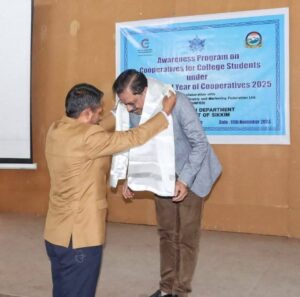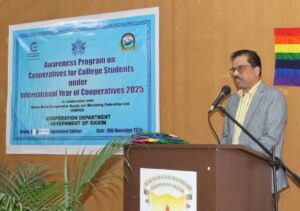
As part of the International Year of Cooperatives 2025, the Cooperation Department, Government of Sikkim, in collaboration with the Sikkim State Cooperative Supply and Marketing Federation Ltd. (SIMFED), organised a one-day awareness programme on cooperatives for the students of NBBGC, today.
The programme was graced by the Principal, NBBGC, Dr. D. Purohit, as the chief guest.
The programme began with a welcome address delivered by the Additional RCS Headquarters, Mr. P. T. Lepcha.
The chief guest expressed his gratitude to the Cooperation Department for organising the awareness programme and said that such initiatives give students a useful understanding of how cooperatives function. He encouraged the students to keep learning at every stage of life, adding that learning does not stop with formal education.
He spoke about Verghese Kurien and the White Revolution, explaining how cooperative efforts helped shape India’s dairy sector. He also shared the story of Lijjat Papad in Gujarat as an example of how a simple idea, supported by collective effort and discipline, can grow into a successful enterprise. Dr. Purohit urged the students to take inspiration from these examples and work towards becoming self-sufficient and self-empowered. He mentioned that the college will allot a plot of land for agricultural activities. He added that the students, in coordination with the Cooperation Department, will use this land to gain practical exposure to agriculture and develop a better understanding of cultivation and land management. He said that the initiative will help students build a closer connection with the land and appreciate the value of agricultural work.
The guest speaker, CGM SIMFED, Mr. Jeewan Sharma, spoke about the foundation and growth of the cooperative movement. He explained the origins of cooperatives and referred to Robert Owen as the Father of the Cooperative Movement. He shared how cooperatives first developed in India and in Sikkim, noting that the system in Sikkim began during the monarchy. He highlighted the two-tier cooperative structure comprising state-level and grassroots institutions and spoke about the role of multipurpose societies.
Mr. Sharma also outlined the work of SIMFED as the state’s apex marketing cooperative federation, supporting procurement, supply and marketing services for cooperative societies across Sikkim.
The Additional RCS Headquarters, Mr. Robin Sewa, expressed his happiness to be among the students and welcomed the opportunity to share information on the cooperative sector. Mr. Sewa spoke about the challenges and achievements of cooperatives in the state and encouraged students to understand their role in community and economic development. He referred to the five elements of nature and linked them to Sikkim’s focus on sustainability, encouraging students to remain connected to their environment and adopt practices that support responsible living. He also addressed concerns relating to arsenic content in food and ADHC deficiency, stressing the need for awareness about such health issues. He explained that Sikkim’s emphasis on organic agricultural production is aimed at ensuring safe and clean food, protecting soil health and promoting sustainable farming practices. He encouraged the students to understand these concerns and remain mindful of the quality and sources of the food they consume. Further, he highlighted efforts towards the revival of barren lands, explaining that converting unused and degraded land into productive areas supports food security, environmental restoration and community livelihoods. He encouraged students to understand the value of responsible land use and to take interest in initiatives that contribute to ecological balance and long-term sustainability.
The Assistant RCS, Mr. Tsewang N. Bhutia, presented an awareness PPT covering:
* Concept of cooperative societies
* Cooperative movement in India and Sikkim
* Key milestones of Sikkim’s cooperative sector
* Cooperative Societies Act and Rules in Sikkim
* Principles and values of cooperatives
* Roles and responsibilities of cooperative societies
* Functions of the Cooperation Department, Government of Sikkim
* Process for registering a cooperative society in Sikkim
* State government support to cooperative societies
* Apex cooperative institutions in Sikkim
* Major initiatives of the Ministry of Cooperation
A separate presentation on cooperative audit was delivered by the Joint RCS, Mr. Rohit Rasaily. The session covered:
* Fundamentals of accounting
* Cash book maintenance
* General, loan and share ledgers
* Receipt and payment vouchers
* Stock register
•Computerisation of PACS
It may be noted that the United Nations has declared 2025 as the International Year of Cooperatives under the theme “Cooperatives Build a Better World”. In India, the observance aligns with National Cooperative Week held every year from 14 to 20 November, focusing on awareness, outreach and strengthening cooperative activities.
Also present were Assistant Professor, NBBGC, Dr Deepak Adhikari, officials and staff from the Cooperation Department and students. The programme concluded with a vote of thanks delivered by Senior Audit Officer (Gangtok), Mr Sailesh Rai.